
Spanish Colonial Revival Interiors in Los Angeles: A Designer's Guide to Restoring Character Without Losing Livability
Yes — you can renovate a 1920s Spanish house in Los Angeles without ruining it. The rule I give clients on our first call: restore what is original and irreplaceable, change what was always a compromise. Plaster, arches, tile, beams, and windows are the character. A closed-off kitchen, one bathroom for four people, and forty-year-old wiring don’t constitute character. They're just old.
Los Angeles built these houses in an astonishing burst, roughly 1915 to 1935. The 1915 Panama-California Exposition in San Diego made the style a civic fashion, the city's population more than doubled in a decade, and speculative builders put up Spanish Colonial Revival bungalows and two-story houses by the thousand. That's why you can stand on one block in Eagle Rock and count six.
Almost every buyer I meet has inherited one of two conditions. Either the house was stripped in a 1990s renovation — arches squared off, plaster skim-coated flat, original tile in a dumpster — or the character survived intact and the kitchen, baths, systems, and layout are forty years past useful. Both are fixable. Neither requires choosing between a museum and a gut job.
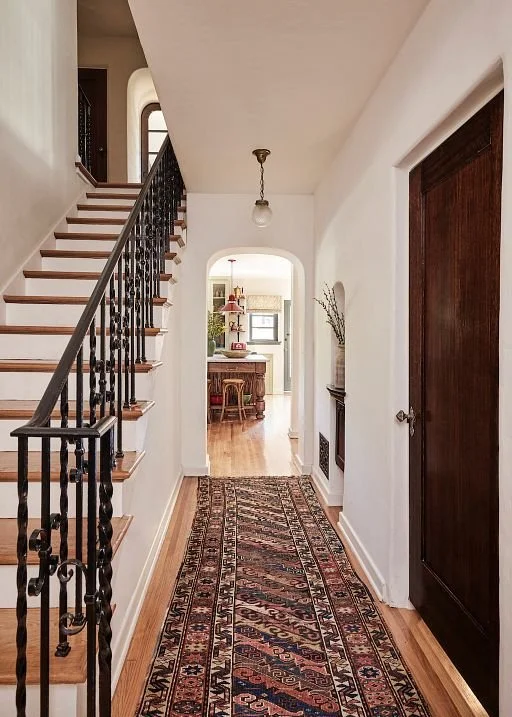
What Makes a Los Angeles Spanish Colonial Revival Home
The style is a specific architectural vocabulary, not a mood. In Los Angeles you're almost always looking at some combination of:
Arched openings — doorways, passages, niches, window heads, usually a flattened or segmental curve rather than a true half-round
Thick plaster walls, hand-troweled and slightly irregular, with rounded corner returns
Clay tile roofs in barrel or S-tile profile, low pitched, minimal eave overhang
Deep-set windows — the wall thickness is expressed as a reveal, which is why flush replacement windows look wrong
Wrought iron — grilles, stair rails, sconces, gates, hinges, cabinet pulls
Decorative tile — stair risers, fireplace surrounds, kitchen and bath walls; Malibu, Catalina, or Batchelder in the good ones
Ceiling beams, structural or applied, sometimes stenciled
Courtyards and loggias — the plan usually organizes around getting outside
Asymmetrical massing with a chimney or tower as the visual anchor
Where they cluster: Pasadena, Highland Park, Eagle Rock, Echo Park, Silver Lake, Los Feliz, Hancock Park, Windsor Square, and the adjacent San Gabriel Valley cities including Alhambra, South Pasadena, and San Marino. Several of those are separate municipalities from the City of Los Angeles, which matters once you get to permits and historic designation.
It is worth knowing whether you have a Spanish Colonial Revival house or a Mediterranean Revival one, because they aren't the same style and people use the terms interchangeably. The short version is in the FAQ below.
The Three Mistakes That Ruin a Spanish Revival Interior
1. Over-theming. The most common one and the hardest to talk people out of. You add a wrought iron chandelier, then a Talavera sink, then a Saltillo floor, then a carved chest, and at some point you've stopped living in a house and started living in a restaurant. These were ordinary middle-class homes, not monuments to Spain. The architecture already carries the story; your job is to stop underlining it.
2. Erasing. The beige-and-travertine gut. Arches squared, plaster flattened, tile removed, dark wood painted white, casements swapped for vinyl sliders. More is recoverable than people assume: plaster texture can be restored, arches rebuilt from a matching opening elsewhere in the house, and reproduction tile has gotten very good. What can't be recovered is original tile that went in a dumpster and original wood windows once they're gone. Everything else is money and patience.
3. Ignoring the architecture. Buying a sofa for a room whose walls curve at the corners and whose openings are arched, then wondering why nothing sits right. Heavy rectilinear pieces fight the plaster; low modern seating looks marooned under a nine-foot arch. This is the mistake that costs least to avoid and most to fix.
Working With What's Already There
Plaster. Original plaster is lime or gypsum over wood lath, and you can identify it three ways: the wall sounds solid rather than hollow, corners return in a soft curve instead of a crisp bead, and the surface has a hand-troweled variation no texture spray reproduces. If it's original and sound, don't skim-coat it flat. Repair cracks with a compatible patching plaster, feather the repair into the existing texture, and paint flat or matte — eggshell and satin read as plastic on a troweled wall. If the plaster is gone, a lime-based finish plaster over new drywall gets you most of the way back, at real cost. Venetian plaster is not the same thing and will read as a 2004 hotel lobby.
Arched openings. Squaring off an arch is a mistake with compounding interest: once one opening in an enfilade is square, every remaining arch looks like an accident. If you need a wider opening, widen the arch rather than replace it — a good plasterer can spring a new curve from the existing haunches, and a lost arch can be rebuilt from the profile of an intact opening elsewhere in the house. If an arch truly has to go, remove the whole run so the room reads as intentional rather than damaged.
Original tile. Restore first, reproduce second, replace last. Restoration is often just careful cleaning and regrouting — much of what looks like ruined tile is decades of the wrong sealer. If pieces are missing, take a good one to a tile maker; several California studios still press-mold and hand-glaze in the 1920s palette. And if tile comes out during construction, have your contractor save every piece, including the broken ones.
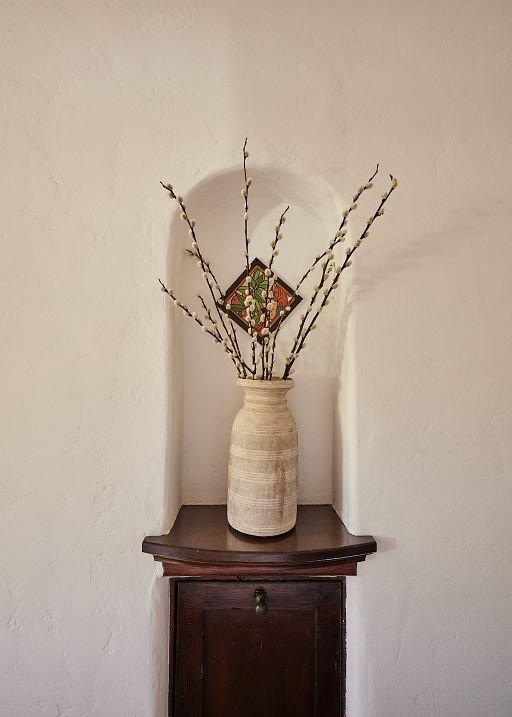
Photo by Jenna Peffley
Ceiling beams. Real versus applied is easy to test: tap them, and look at where they meet the wall. Structural beams engage the wall plate and align with the framing above; applied beams are hollow boxes, often slightly off-module. Both are legitimate — applied beams were used from the start, not just by later remodelers. What matters is finish: beams polyurethaned to a plastic gloss can be stripped back and oiled or waxed, and the difference in a room is enormous. Painting beams white is defensible in a dark room and hard to reverse (paint can be stripped – but it’s a big job), so decide slowly.
Windows. Original steel casements are worth keeping if they're operable — reglazed, with new gaskets and restored hardware, they give sightlines no new unit reproduces. Original wood windows are worth keeping almost without exception; old-growth timber outlasts anything you can buy. On the Pasadena Spanish we kept every original window and door and put the budget into the kitchen. Vinyl retrofits set flush to the plaster are what make a restored Spanish house look, from the street, like it wasn't. We also use replacement original salvage wooden sashes to slot in for replacing a vinyl retrofit; so we can replace the replacement!
The Kitchen Problem
Original Spanish Revival kitchens were small, closed, and built for staff or for one person cooking alone. That's the sharpest conflict between these houses and the way anyone lives now, and it's where most of the budget goes.
On opening it up. I do open kitchens and I'm not precious about it. On the Alhambra Spanish we opened one wall to the living room, took down the smaller walls around the breakfast nook, and removed doors that did nothing. On the Pasadena Spanish we removed two walls to make one large family kitchen with an island seating four, and moved the laundry upstairs to buy the square footage. Both were right.
But there's a version of opening up that quietly ruins the house — the one where every wall on the first floor comes down and the sequence of rooms, the actual pleasure of a Spanish plan, disappears into one bright rectangle. On the Eagle Rock Spanish II we did the opposite: kept the original footprint, widened doorways everywhere, and took down exactly one wall, between the galley kitchen and the dining area. The house feels twice as generous and reads entirely as itself. Widening openings does most of the work of removing walls without the loss.
Color as the resolution, not scale. When a kitchen can't get much bigger, it can get much better. Charcoal blue cabinets in Alhambra. Farrow & Ball blue with a reclaimed wood island top in Echo Park. Green cabinetry in Pasadena. A small kitchen in a strong color is a room; a small kitchen in white is a small kitchen.
Tile, hardware, appliances. Patterned tile run to the ceiling — what we did in Alhambra — makes a low room taller and does more for a modest kitchen than square footage would. Unlacquered brass, bronze, or nickel over chrome; cross-handle faucets; pick one metal and hold the line - or mix metals with aplomb, but keep it limited to two choices. And panel the refrigerator and dishwasher into the cabinetry, letting one thing be metal, usually the range. The Pasadena Spanish is all new Wolf and Sub-Zero and reads as a kitchen rather than an appliance showroom, because of the addition of a custom painted wood oven hood, and the oversized oak island in the style of a French Country farm table.
If a kitchen or a single bath is the whole of what you need, that's our Limited Scope service.
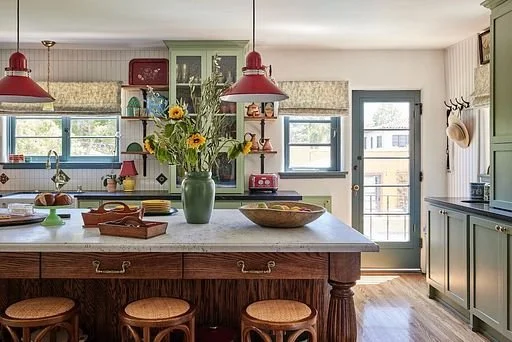
Photo by Jenna Peffley
Bathrooms, Zellige, and the Case for Pattern
Bathrooms are where I argue hardest for pattern and color, and where the work has traveled furthest — Good Housekeeping and Architectural Digest have both run JCD walk-in showers in their shower design roundups.
Zellige is the reason. It's hand-formed Moroccan clay tile, glazed and fired so no two pieces share a dimension or exactly a color, and the surface moves in light the way a plaster wall does. It belongs in these houses because it's made the way their original tile was made. We used pink zellige on the Eagle Rock Spanish II, in a shower inside a bathroom carved out of what had been a hallway, paired with a vintage dresser converted to a vanity. On the Echo Park Spanish we removed an awkward soffit, took out a dated tub, and built a zellige walk-in shower with blue patterned wallpaper around it.
Two practical notes. The variation that makes zellige beautiful makes a tight grid impossible — use a wider grout joint and hire a setter who has worked with it, because it can't be laid like porcelain. And order 20 percent overage; lots vary and reorders won't match.
The other argument is the floor. The black-and-white checkerboard bath on the Pasadena Spanish, with its green vintage vanity, is the most photographed room in that house. Checkerboard is period-appropriate, cheap relative to its impact, and impossible to get tired of.
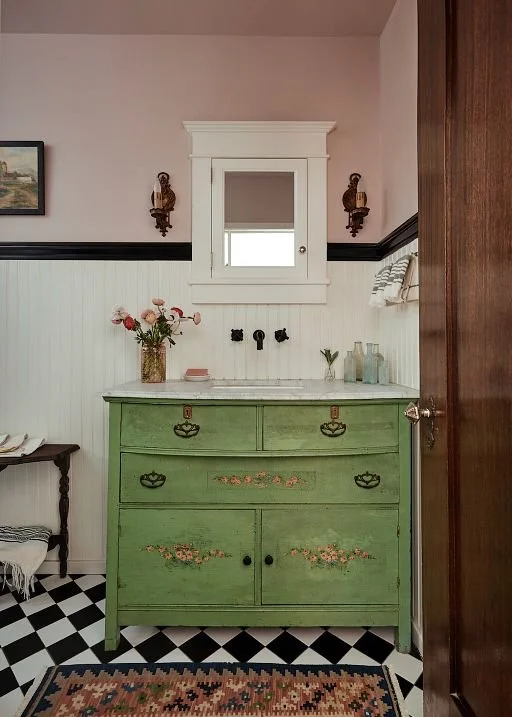
Photo by Jenna Peffley
Color and Pattern in a Spanish Colonial Interior
Here's the orthodoxy I disagree with most: that a Spanish house wants white plaster, terracotta, black iron, and nothing else.
That palette isn't historically pure. It's a photography preference that hardened into a rule sometime around 2016. The original houses were full of color — the tile was green and ochre and cobalt, ceilings were stenciled, doors were painted. The instinct that these rooms should be beige is a modern one, and it produces houses that are handsome and slightly dead.
What I actually do: saturated, slightly dusty colors that hold up against warm plaster and warm wood. Put the strong color on the millwork and walls rather than only on the furniture — the architecture carries far more than people expect. Mix pattern scales deliberately: one large, one small, one geometric. And use white as relief between colors rather than as the ground everything sits on.
A Spanish house isn't just Spanish once I've finished with it. It's the best version of the house it originally was.
Furnishing Without Building a Period Room
The goal is a house that looks collected over decades, not shopped in a weekend.
Mix boldly or don't mix. Timid mixing — one mid-century chair in an otherwise matched room — reads as a mistake. Confident mixing reads as a life. English country antiques with Italian mid-century pieces; carved Spanish furniture with African stools.
Buy vintage for the bones of the room — case goods, tables, mirrors, lighting. They bring the patina that new furniture can't manufacture and are frequently better made. Our Chairish shop is where the overflow from projects ends up.
Include something made by hand. A room with no evidence of a human hand feels like a rendering.
Favor natural materials that patina — wool, linen, leather, stone, unlacquered metals. In a house with hand-troweled walls, a factory-perfect surface looks like a visitor.
Bring plants in, seriously. These houses were designed around a relationship to the outdoors. A courtyard-facing room with nothing green in it is missing a structural element.
Four Los Angeles Spanish Colonial Projects
Pasadena Spanish— A two-story Spanish in Pasadena's historic Orange Grove Boulevard district, beautiful in front and unusable behind: a small closed kitchen, a badly placed bathroom, no powder room, no family space. We gut-renovated the back half of the first floor, moved the laundry upstairs, removed two walls to make a family kitchen with an island seating four, relocated the bath, and built a powder room inside a former coat closet. New oak matched to the rest of the house; every original window and door was kept. In the kitchen, we replaced a vinyl replacement with an original salvage door – a unique style called a Santa Barbara door, where the center panels containing the glazed lights opens to allow a breeze; this was made especially for kitchens!
Eagle Rock Spanish II — A whole-house renovation that never left the original footprint. Rather than removing walls we widened doorways throughout and took down exactly one, between the galley kitchen and the dining room. A former porch became a family snug with custom millwork and double-sided curtains that close it into a guest room. Quartzite counters, inset cabinetry, paneled appliances, zellige backsplash, and a new bathroom built in a former hallway. Photography by Sara Ligorria-Tramp.
Echo Park Spanish— A Spanish bungalow high in the Echo Park hills; the brief was a kitchen and a new staircase to the lower level. We squared off an odd bump in the kitchen wall and replaced two windows on the sink wall so they finally matched in height and placement — a small correction that changed the whole room. New oak floors with a hand-painted checkerboard, Farrow & Ball blue cabinets. We had to keep the stove in the island so we built a new one with turned country legs, painted it Stone Blue to match the cabinets, and added a reclaimed wood island top. Photography by Bret Gum.
Alhambra Spanish— A two-story Spanish in vintage condition, gut-renovated across the kitchen, dining area, laundry, and bath. We opened one wall to the living room and removed the small walls and unnecessary doors around the breakfast nook. Under the existing floor we found original Douglas fir subflooring and refinished it as the finished floor — the best outcome available in a renovation, and pure luck. Charcoal blue cabinets, patterned tile to the ceiling, and a restored salvage vintage leaded glass window over the sink was added; a replacement of the replacement! Houzz named the kitchen a Kitchen of the Week.
Frequently Asked Questions
How much does it cost to renovate a Spanish Colonial home in Los Angeles?
It depends almost entirely on whether you're touching structure and systems. Furnishing and decorating an intact house is a different order of magnitude from a renovation that moves walls, plumbing, and electrical — and in a 1920s house, the second always finds surprises.
As a starting point: a kitchen-only renovation begins around $100,000. Our Alhambra project came in near $110,000 several years ago, which gives you a sense of scale, though costs have moved since. A whole-house renovation reaches $300,000 without difficulty, and because there is no ceiling on finishes, it can go well beyond that.
What matters more than any of these numbers is that we will work with the budget you actually have, as long as it sits in a realistic zone. Tell us the number and we will tell you honestly how much of the house it can reach. We are dream enablers, not dreamkillers.
Can I open up the floor plan in a Spanish Colonial house?
Yes, and often you should — selectively. Removing one or two walls to connect a kitchen to a dining or living room usually improves these houses enormously. Removing every wall on the first floor destroys the sequence of rooms that makes a Spanish plan pleasurable. Widening existing openings is the underused move: most of the light and flow of an open plan, rooms still legible.
Is my Spanish Revival home protected by a historic designation?
Possibly, though less often than people assume — and it's worth checking before you plan anything.
The City of Los Angeles has more than thirty Historic Preservation Overlay Zones, which are locally designated historic districts with design review over exterior changes visible from the street. The important thing to understand is that an HPOZ is usually a specific pocket within a neighborhood rather than the whole neighborhood. Hancock Park, Windsor Square, Angelino Heights, and Highland Park–Garvanza all contain HPOZ boundaries, but living nearby is not the same as living inside one. None of the four houses in this post sit in an active HPOZ.
Inside an HPOZ, exterior alterations, additions, and demolition require review; interior work generally does not. Any City of Los Angeles address can be checked through the Planning Department's ZIMAS lookup. Pasadena, South Pasadena, Alhambra, and San Marino are separate cities with their own landmark programs, so an address in any of them has to be checked with that city directly. One should always check to make sure whether your house is in an HPOZ as the lines drawn for the districts are very specific. Not every house in a neighborhood is considered a contributing home to the historic district.
We have worked inside an HPOZ — an early renovation on Irvington Place — so the review process is familiar territory if your house turns out to be in one.
What's the difference between Spanish Colonial Revival and Mediterranean Revival?
Spanish Colonial Revival looks to colonial Mexico and the Southwest: plainer, more sculptural, white plaster, small openings, one concentrated area of decoration. Mediterranean Revival draws on Italian and coastal French sources and is grander and more formal — symmetry, cast-stone detail, balustrades, larger windows. In shorthand, Spanish Colonial Revival is a farmhouse that got beautiful; Mediterranean Revival is a villa that started that way. Most LA bungalows are the former; many of the large Westside estates are the latter.
All of that is true, and none of it should be applied too strictly. These labels were invented after the fact to describe what had already been built, so a generous amount of leeway is useful when you're identifying your own house. Remember that this is a Revival style to begin with — a second-generation interpretation of something done a long time ago and far away. We talk about Tudor houses without feeling the need to say Tudor Revival, because everyone knows the Tudor period belongs to Shakespeare and Elizabeth I and no one imagines a house in Los Angeles dates from it. Spanish Colonial Revival deserves the same easy handling.
Where do I find original or matching reproduction tiles in Los Angeles?
Three sources, in order. Architectural salvage yards, for original 1920s tile in small quantities. Tile makers still produce period profiles, several of whom can match from a sample. And your own house: pull tile from a closet floor or utility area to patch a visible room. Bring a physical piece rather than a photo; glaze color can't be matched on screen. I am happy to share two of the best sources for vintage tile in LA: Wells Tile & Pottery - https://www.wellstile.com/presided over by Scott Wells, a foremost authority on early California tile and pottery, and a good friend, and Nonato Ceramics https://www.nonatoceramics.com/, owned and operated by Jose Nonato, another friend and collaborator. This tile factory is still making tile the old-fashioned way, just as they did in the 1920’s and 30’s. Jose himself does some of the best installations in the city if you can afford him. But don’t be afraid to find contemporary reinterpretations of older tile designs and styles at places like Mission Tile West, of a more unique artists studio that I use a lot: RTK - http://rtkstudios.com/run by family members Richard and Mary Keit in Ojai, where you will see their designs and tile installations all over the city in public and private spaces alike.
Should I restore original windows or replace them?
Restore, in nearly every case. Original wood windows are old-growth timber and outlast any replacement; steel casements can be reglazed and rehabilitated. Restoration is often cheaper than a good replacement, and always cheaper than installing bad windows and regretting them later. If a window is genuinely beyond saving, specify true divided lites, matching sightlines, and a deep-set installation that preserves the reveal in the plaster. But often you will be dealing with windows that have already been replaced – usually with vinyl or other less than appropriate materials. In those cases – replace the replacements! And if you can, look for matching salvage sashes or other elements, like casings, to be found at studios like Pasadena Architectural Salvage https://pasadenaarchitecturalsalvage.com/or Freeway Building Materials https://www.freewaybuildingmaterials.us/. These are the best places in LA. Other areas have their own vendors, so just search architectural salvage.
If you have a Spanish house in Los Angeles and you're trying to work out what to keep and what to change, that's the conversation I most like having.Book a free discovery call.
